

On September 14, a DeepSeek machine learning systems engineer named Liu Shengyu (刘胜与) published an essay on his personal WeChat account titled "I Have No Choice but to Bury My Talent in Yesterday" (《我不得不把才华埋葬在昨天》). Four days earlier, DeepSeek shipped V4.1-Flash, the model whose main attention kernel Liu wrote. He argues that within six months to a year, AI will write kernels as well as he does, that he will keep his job but lose the work he loves. The post drew more than 100,000 reads on WeChat, hit number one on the Zhihu hot list, and was translated into English and Japanese on X. Chinese coverage and Liu's own follow-up clarify what most sensationalist English reports missed: the viral hook was a labor story, and the fight it triggered was about who controls frontier intelligence.
Background
Liu was a member of Peking University's 2021 Turing Class (图灵班), the university's elite undergraduate computing program, and captained PKU's Weiming supercomputing team at the SC23 student cluster competition. He joined DeepSeek in April 2025. His essay opens by naming his contribution: "I am of course proud of DeepSeek V4.1's success, since I wrote its main Attention kernel."

Liu Shengyu's GitHub profile picture. His profile lists @deepseek-ai as his employer and Hangzhou as his location, under the handle interestingLSY, the same name he publishes the WeChat account where the essay appeared.
A footnote however is present which is that the the "main Attention" covers only the head dimension 512 MQA attention. The indexer that selects the top-k important tokens was written by other colleagues, "and their own respective AI agents."
The argument put forth by Liu is not that machines are coming for programmers in general but rather that Kernel quality determines how fast a model trains and runs, so Liu's own work accelerates the thing that makes him redundant: "I know full well that the better I write kernels, the faster our new models will be trained and run inferencing, the faster model capabilities advance, and the sooner I am replaced."
His throughput comparison became the most-quoted passage:
"AI can reason at 300 tokens a second, type out a line of command in half a second, and finish a piece of code in twenty seconds. I cannot. AI can keep increasing its model depth, reasoning effort, tool-call volume and even degree of parallelism. I cannot."
He gives AI roughly a year to match him, noting that in twelve months his assistant went from hunting bugs to reading CUDA, PTX and SASS, analyzing the stall time of each instruction with profiling tools, and optimizing kernels on its own.
A GPU kernel is the computation unit that actually runs on the hardware, at the bottom of the AI stack. Attention kernels matter disproportionately because self-attention's time and memory costs scale quadratically with sequence length, so how work is tiled between high-bandwidth memory and on-chip SRAM sets the ceiling for the whole model.
The toolchain has three levels. Engineers write CUDA C++; the compiler emits PTX, a documented virtual instruction set that survives across GPU generations; a final assembler turns PTX into SASS, real machine code for one chip generation. Optimizing here means reasoning about memory latencies above 100 clock cycles and diagnosing warps stalled on a memory dependency rather than doing math.
The field's own numbers show the difficulty. A naive CUDA matrix multiplication kernel reaches about 1.3% of the vendor library's performance, and closing that gap takes ten separate non-obvious techniques. FlashAttention, the algorithm that made long-context models practical, reached only 25 to 40% of theoretical peak throughput in its first version. This is the work AI is now reported competent at.
References within his essay.
"Humanity has never shown much hesitation when it comes to destroying itself... I would of course rather not be revolutionized. But if I must be, I would rather be the person who revolutionizes myself."
The essay is dense with loaded terms and references in Mandarin that may not be able to be understood by our western friends, these are explanation of terms used within Liu’s essay.
摆烂 (bǎi làn). To let things rot. Liu asks why he still optimizes when he knows it hastens his replacement. Even if he slacked off or "tripped up model training on purpose," rival labs' models would advance and kill him off anyway.
革自己的命 (gé zìjǐ de mìng). To revolutionize oneself. Borrowed from political vocabulary and used ironically: to be the agent of your own displacement.
屎山 (shǐ shān). Quite literally “A mountain of shit”. Programmer slang for an unmaintainable codebase. Liu warns that a poor engineer armed with AI produces shit-mountains several times faster, making the world more 草台 (cǎotái), a slapdash operation, from the term for a makeshift rural opera troupe.
机甲驾驶员 (jījiǎ jiàshǐyuán). Mecha pilot. Otaku-derived shorthand for his forced pivot from writing kernels by hand to directing AI agents. "My hands hold more gears now, but my heart has fewer rhythms."
织毛衣 (zhī máoyī). Knitting a sweater. His central metaphor: a knitter whose skill is matched by a machine, who keeps the income but loses the craft. "The pleasure of sitting by the window, threading needle through thread, letting the hours pass slowly, was in the end crushed by the roar of the machine."
滑动变阻器 (huádòng biànzǔqì). Sliding rheostat. A separate community meme: DeepSeek founder Liang Wenfeng's (梁文锋) reputation slides between "Saint Liang" (梁圣) and the dismissive "Liang-zi" (梁子) as releases meet or miss expectations.
Guancha (观察者网) recorded readers treating the essay as a reply to Western labs. One widely circulated comment framed it as romantic rather than bitter: a man displaced by technology he built, thinking about how to pass the flame on rather than how to keep his seat.
The open-source argument, and the line everyone quoted
The essay's last third is political, which is why it traveled beyond Chinese tech circles. Liu contrasts two futures: communism, or Cyberpunk 2077, where a few companies hold the most advanced AI and everyone else gets a crippled version. He names the company he distrusts:
"I do not trust Anthropic or OpenAI to do that. In particular, I do not want Anthropic to control the most advanced AI or AGI. To put it dramatically, the severity is no less than letting Hitler get the atomic bomb before the Allies."
That line drove the English coverage. It is a kernel engineer's hyperbole, not company policy, and many reports dropped what followed, this is why he stays at DeepSeek, because "we research powerful, fast, broadly accessible AI and open-source it." He added, parenthetically, "I'll leave it at that, or I'm afraid this won't pass moderation."
Two days later Liu published a supplement that partly withdrew the framing. His purpose, he wrote, "was not to express anxiety about unemployment, and even less to stress DeepSeek's openness and Anthropic's unpleasantness," but to say goodbye to hand-writing kernels. He remains optimistic about AI and pessimistic about human attention. Journalists read geopolitics into a piece about craft.
What China's record actually shows
The open-versus-closed argument rests on checkable evidence. DeepSeek's release record is documented: under the MIT license for code, it published FlashMLA, DeepGEMM, DeepEP, DualPipe and 3FS, one repository a day during its February 2025 Open Source Week, alongside model weights on Hugging Face. Global Times editorials frame this as treating AI as a public good, and in July 2026 the paper put cumulative downloads of Chinese open-source models above 10 billion.
Two complications belong alongside that. DeepSeek's weights ship under a separate model license, not the MIT license covering its code repositories, so "open" describes the infrastructure more cleanly than the weights. And Liu wrote the V4.1 kernel largely by hand, which makes his essay a report on a transition underway rather than a finished one.
The hardware story is more clearly favorable. V4.1-Flash is a 552-billion-parameter mixture-of-experts model with an asymmetric encoder-decoder architecture, 8 billion active parameters on input and 16 billion on output, and a KV cache one quarter the size of the previous generation in HBM.
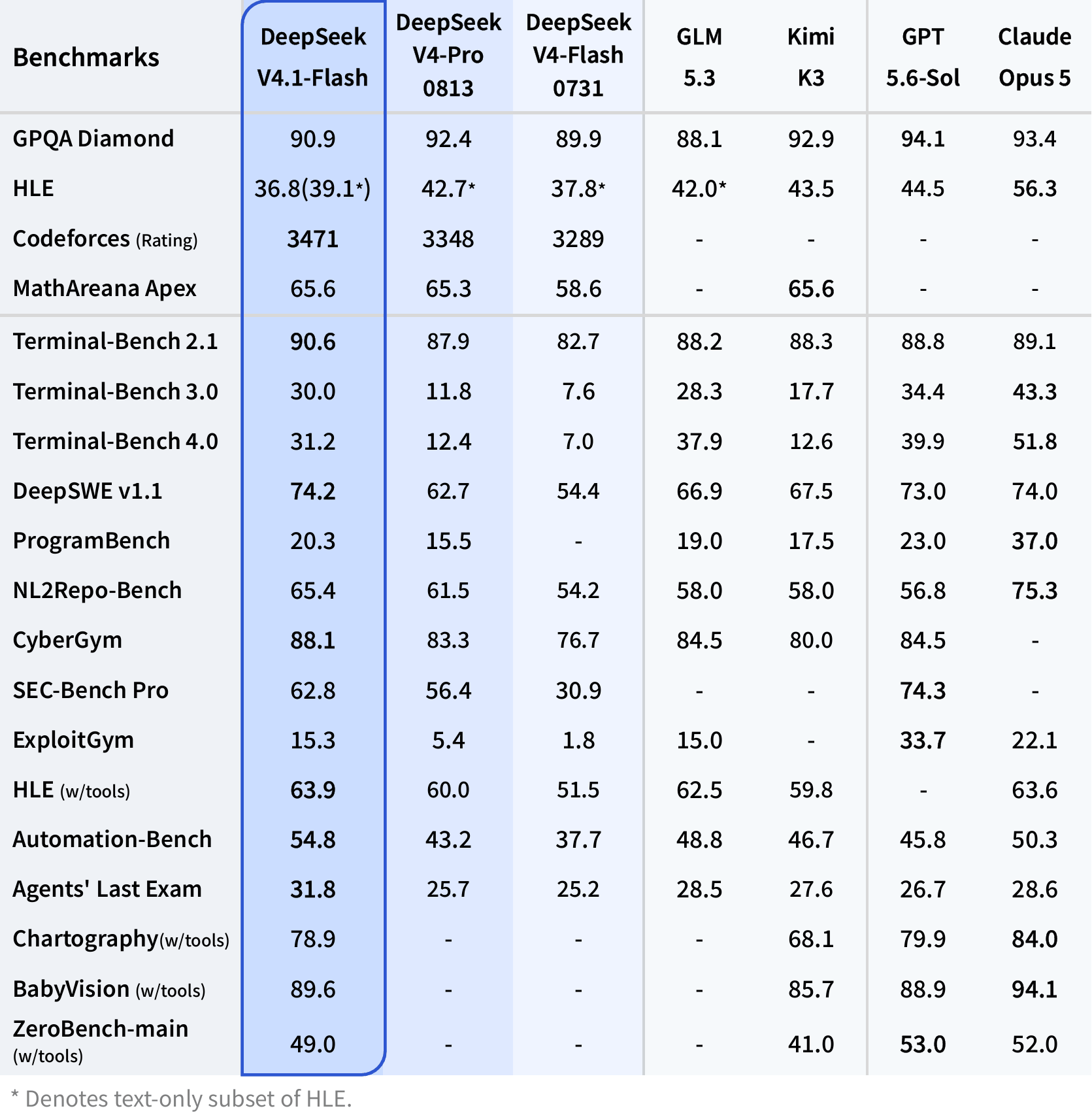
A benchmark chart from DeepSeek's official V4.1-Flash announcement. DeepSeek states that tests by multiple parties put V4.1-Flash ahead of V4-Pro on performance, cost, speed and total runtime.
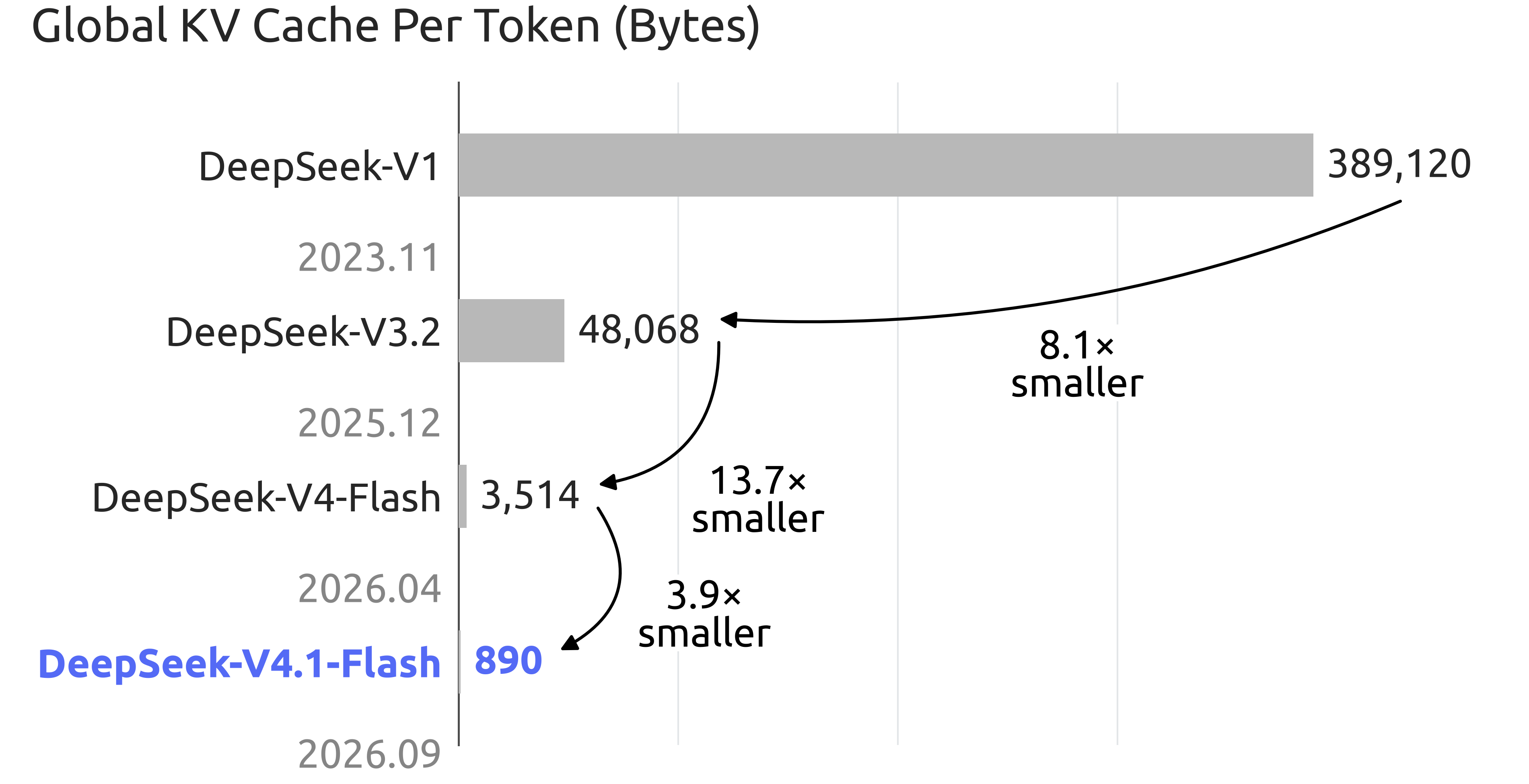
DeepSeek's KV cache comparison for V4.1-Flash. The company reports the model needs one quarter the HBM and one eighth the SSD storage of the previous generation.
At the China Computing Power Conference (中国算力大会), held in Langfang from September 11 to 13, a consortium led by China Mobile's Suzhou software unit demonstrated a heterogeneous inference system splitting transformer work across domestic GPUs and a neuromorphic chip, using compute-in-memory for latency-sensitive expert layers. Running DeepSeek V4 Flash on three GPU servers and three neuromorphic cabinets, the group reported more than double the inference output and energy efficiency of a pure-GPU cluster of equal cost, operating costs down more than 40%, and 15 granted invention patents, with no reliance on advanced overseas chips or process nodes. DeepSeek is separately preparing a STAR Market listing through CITIC Securities, reported at a 500 billion yuan valuation, for a 2027 debut.
The Ending
Liu closes with a prediction rather than a lament. One day, he writes, "hand-writing kernels and even programming may become a recreational activity rather than a productive activity, the way almost nobody hunts with a javelin now, but treats it as a competitive sport."
Stripped of the Hitler comparison and the meme culture, that is the part with no national boundary in it. A tool built to amplify a person's ability has exceeded it, and the person who built it said so first, in public, with a timeline attached. Whether open weights or closed labs steward that capability better is being argued in the same essay, by the engineer it is happening to.
What did Liu mean by “Communism or Cyberpunk 2077”
The passage that carried the essay beyond China's tech circles is usually quoted as a one-line provocation. In the actual essay however, it sets up two futures and picks a side.
"Along with AI's development, future society may tend toward two extremes: communism, and Cyberpunk 2077 ( The Game). In the first, the productive forces are enormously liberated and people's living standards rise markedly (let me just write this much, otherwise I am afraid it will not pass moderation). In the second, a small number of technology companies control most of the resources; only a very few people can use the most advanced AI and technology of every kind, achieving something close to "mechanical ascension," while most people get only very weak AI. Crossing class lines will become harder and harder: you first have to have the strongest AI in order to cross classes and indirect caste, which forms a dead loop."
Liu describes the communist pole in a single clause. That phrasing is not his invention. It is a vernacular rendering of the standard formula in Chinese Marxist theory: Qiushi (求是), the Communist Party's flagship theoretical journal, describes the full realization of communism as requiring "a high level of development of the social productive forces" and "great abundance of social products." Liu borrows the official vocabulary of material abundance and applies it to one specific technical condition, that advanced AI is available to everybody.
The other pole is more concrete and gets more of his words. Cyberpunk 2077 is the CD Projekt Red game released in December 2020, set in Night City, a California city-state run by corporations rather than by law. By the time Liu used it, "2077" had served for years as Chinese internet shorthand for corporate dystopia. The genre's core is conventionally summarized in Chinese as 高级科技和低端生活, high technology and low-end life. Guangming Daily (光明日报), in a 2025 commentary, called the genre "essentially a critique of capitalism," one that depicts a dystopia in which "state functions are replaced by corporations and ordinary people are made obsolete by technology," and where "technology is highly advanced yet serves a few multinationals, the underclass suffers, and social division is severe." That is close to a literal description of the world Liu says Anthropic would produce.
One term inside his description needs unpacking. 机械飞升 (jīxiè fēishēng), rendered above as "mechanical ascension," is filed by Baidu Baike as an internet buzzword, and it originates in the strategy game Stellaris (群星). Its "synthetic ascension" path turns organic populations into cyborgs and eventually datafies consciousness, discarding the body. The slogan the community attaches to it is 血肉苦弱,机械飞升, "the flesh is weak, mechanical ascension." Liu puts the phrase in scare quotes, treating it as an established term. In his account it is what the top of the hierarchy gets and everyone else does not: not better tools, but an exit from biological limits that makes humans human.
The mechanism he describes is a loop rather than a ladder. You need the most powerful AI to cross class lines, and only people already at the top are granted access to the most powerful AI. That self-reinforcing structure, not inequality of income, is what he says makes the 2077 outcome hard to reverse.
What is unusual is that a working engineer reaches for the state's own ideological vocabulary to argue about model weights. Liu is not a spokesperson, and two days later he said the framing was not his point. But the contrast he draws is not foreign to official commentary. Guangming Daily's editorial argues that Chinese technology "is not serving a minority of people or institutions, but is people-centered," explicitly against cyberpunk's narrative of technology oppressing people. Liu's two poles map onto an argument already circulating in Chinese public discourse. Whether that makes the essay an authentic expression of a widely shared view or a skilled deployment of sanctioned framing is a question the essay does not settle. A 2025 paper in Frontiers in Political Science makes the skeptical case, arguing that AI in China sits inside a governance model oriented toward centralized control and ideological alignment, which would make the communist framing as much legitimation as description.
The concrete form of the far off future in todays day and age where we can accept is a price list. DeepSeek publishes per-token rates for V4.1-Flash and charges half price off-peak, which its announcement frames as passing on the savings from a more efficient architecture. This allows a near frontier performance model while also keeping affordability in check, allowing independant code developers to have almost the same outputs as “Corpos” for lack of a better word that may have access to higher monetary means to afford frontier coding models such as Claude Or Codex.
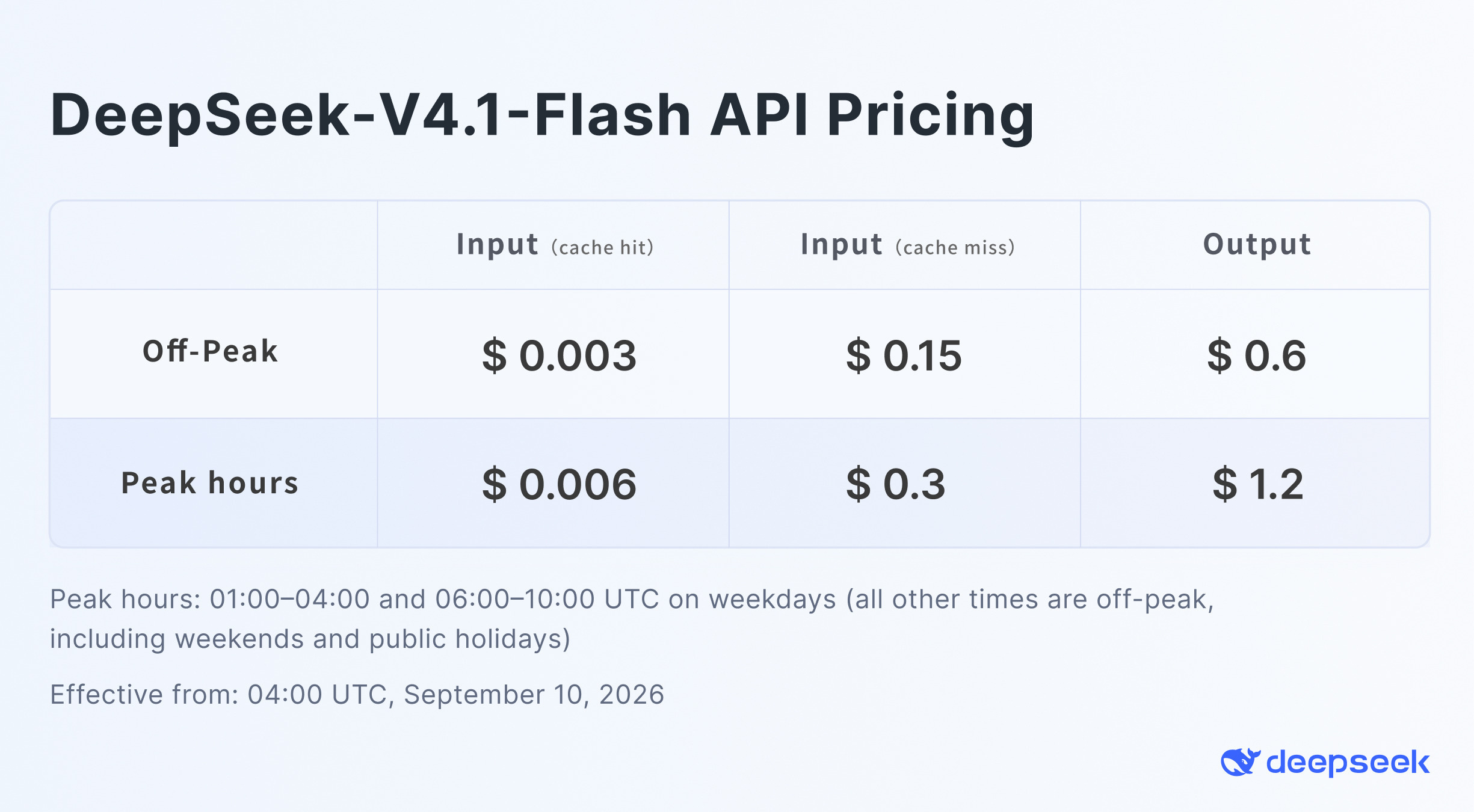
DeepSeek's published pricing for V4.1-Flash, from the official announcement. Off-peak rates are half of peak rates, the concrete form of the open and cheap access Liu argues for.
The essay in full: I Have No Choice but to Bury My Talent in Yesterday
What follows is the complete essay, translated. The two subheadings are the author's. It was published on his WeChat account on September 14, 2026, under the title 《我不得不把才华埋葬在昨天》.
A few days ago DeepSeek v4.1 was released, pushing the ceiling of small-model capability up another notch.
The pace of AI development has far outstripped everyone's expectations. From the first version of ChatGPT, which could do little more than babble in conversation with a context window of a few thousand tokens, to reasoning models like OpenAI o1, DeepSeek R1 and Kimi K1.5 Thinking, took only two years. From reasoning models to today's agents, which execute commands and complete complex tasks fluently inside all kinds of harness tools, took only a year and a half. It is hard to imagine what AI will be like in another year, two years, three years: how powerful it will be, whether it will already have the capacity to improve itself, and how deeply it will have penetrated embodied intelligence and other fields.
AI is getting better and better at writing kernels
AI has advanced just as fast in the field I work in, kernel design and kernel writing. In the space of a single year it has gone from an assistant that could only help me search documentation, read code and hunt for bugs, and transformed into a kernel master able to read CUDA, PTX and SASS on its own, use professional tools to analyze the stall time of every instruction, and then optimize kernels independently. I believe that before long it will also be able to design kernel schedules on its own, evaluate the performance of different scheduling schemes, and implement and optimize them.
I am of course proud of DeepSeek v4.1's success. After all, I wrote its main Attention kernel, and its excellence is an affirmation of my kernel. But the wheels of the era roll forward, and nobody can stop the advance of technology. I know perfectly well that in another six months or a year, the kernels AI writes will most likely be as good as mine, or better. AI can reason at 300 tokens a second, type out a command line in half a second, and finish a piece of code in twenty seconds. I cannot. AI can keep improving its model depth, its reasoning effort, its tool-call volume (the frequency with which it interacts with its environment), and even its degree of parallelism. I cannot.
Humanity has never shown much hesitation when it comes to destroying itself. Knowing full well that "the better I write kernels, the faster our new models train and run inference, the faster model capabilities advance, and the sooner I am replaced," why do I still choose to optimize kernels as hard as I can? Partly because writing kernels feels to me like playing a game, and gives me enormous pleasure. At the moment I invent a new technique, or see my kernel's performance rise, the excitement is no less than that of a speedrunner breaking their own record. And when I see my kernel substantially outperform the vendor's official kernel, I feel enormous pride. But there is a more important reason besides. Even if I were to slack off entirely, or even deliberately trip up model training, other companies' models would go on developing as usual and would eventually kill me off regardless. "I would of course rather not be revolutionized, but if I must be, I would rather be the person who revolutionizes myself." When everyone is this committed to destroying themselves, I have no choice but to join this brutal arms race.
On the day AI's kernel-writing really does surpass mine, what will become of me?
My judgment is this: I will not exactly be "unemployed," but I will have to "change trades." My rice bowl can be kept, but this may mean I never again get to do the work I once loved.
I once made a judgment about how the era would change and about my own position in the future. Because the era is changing so fast, with AI's development above as a good example, I have no way of predicting what will happen in five or ten years. But whatever happens, I believe that with my perspective, my judgment, my initiative and my intelligence, I can stay at the era's poker table and stand once more at its leading edge. That judgment, though, can only guarantee that I will not be "unemployed." It cannot guarantee that I will not need to "change trades." If anything, it encourages me to change trades in order to avoid unemployment.
So what does changing trades mean? It means giving up the design, writing and optimization of kernels, a field I have worked in for a long time and love deeply, and going instead to be an Agent's "mecha pilot." Before this, my interests, my strengths and what industry needed were basically aligned. Now AI has turned what I am good at into something it is better at, and has shifted industry's demand from "people who can write high-performance kernels" to "people who can use AI to produce high-performance kernels faster." To meet industry's needs I will inevitably have to abandon the direction I loved and turn toward an unknown new one. I believe that with my understanding of engineering, of upper-layer model requirements and of lower-layer hardware, I can keep producing kernels at high quality and high efficiency. I also know I might come to love this new direction, or might not. But having my love taken away from me does not feel good. That quiet joy of sitting at my desk and calmly writing kernels for an afternoon may become a swan song this summer. I have no choice but to bury my talent in yesterday and go be a mecha pilot. My hands hold more gears now, but my heart has fewer rhythms.
Here is a vivid comparison. Suppose you are a master of knitting, especially good at working all kinds of patterns and matching every color. The sweaters you knit are sturdy and beautifully patterned, and rich people from miles around come to ask you to knit for them, so you make a good deal of money. You also deeply enjoy the feeling of sitting by the window, brewing a pot of clear tea, looking out at the green hills, the water, the cattle and the cooking smoke, and knitting quietly for a whole afternoon. Then one day someone invents a miraculous machine that, given wool and a pattern, automatically knits a sweater whose quality and texture are no worse than yours, and far faster. You know very well that your peers can easily reach the standard you once held using this machine, so you have no choice but to use it too. You also know that with the twenty years of knitting skill you have accumulated, even when everyone has a machine, your speed and quality can still beat your peers. But that delight of listening to rain by the window, threading the needle, letting the hours pass slowly, was in the end crushed by the roar of the machine.
I know this is helpless, but there is no way around it. The rice bowl can be kept, but the old love will most likely have to be given up. I am a person whose reason and emotion are fairly well separated. When a problem needs to be handled rationally I can be very rational, but sometimes I also show an emotional side. I remember crying hard when I moved out of a rented apartment I had lived in for a year, unable to bear parting with the memories. Saying goodbye today to that era of hand-written kernels and human-brain optimization is undoubtedly crueler than that.
I do not know whether any reader feels something similar, but I think this can only be how it is.
And what about people?
As AI keeps advancing, I am also worried about some questions.
Are today's students now mostly inclined to use AI to finish their assignments, especially the hands-on Labs? Imagine two choices. One is to slog through a Lab in eight hours, and maybe still not get full marks. The other is to start an AI model and, for a few cents and a few minutes, have AI write full-marks code directly. Which would most students choose?
That leads to a severe shortage of engineering ability among a great many students: the ability to organize code, to build systems, to think about future requirements and address them in the design in advance, to abstract. So against the backdrop of ever-stronger AI, is this "engineering ability" still necessary? Will these engineering abilities gradually be abandoned by the era, the way skill at writing x86 assembly by hand was, or will they hold value forever, the way "understanding the whole computer system from software to systems to hardware" does? If it is the latter, that is dangerous. A person with very poor engineering ability, once paired with AI, can produce mountains of shit several times faster than before, planting all kinds of disasters in the system and making this world more of a slapdash operation.
In the future society, will power matter more than technology or intelligence?
These questions perhaps only the era itself can answer.
Along with AI's development, future society may tend toward two extremes: communism, and Cyberpunk 2077. In the first, the productive forces are enormously liberated and people's living standards rise markedly (let me just write this much, otherwise I am afraid it will not pass moderation). In the second, a small number of technology companies control most of the resources; only a very few people can use the most advanced AI and technology of every kind, achieving something close to "mechanical ascension," while most people get only very weak AI. Crossing class lines will become harder and harder: you first have to have the strongest AI in order to cross classes, which forms a dead loop.
If Anthropic permanently holds the most advanced AI in the world, will future society become Communism or 2077? Guess.
So I still believe that the most frontier intelligence should be supplied to everyone in an open, cheap way. I do not trust Anthropic or OpenAI to do that, and I especially do not want Anthropic to hold the most advanced AI or AGI. To put it dramatically, the severity is no less than letting Hitler get the atomic bomb before the Allies. This is also why I chose, and insist on, staying at DeepSeek: we research powerful, fast, inclusive AI and open-source it, which may pull the world back a little from the 2077 end.
May all be well with the world to come. May all the beauty be blessed.
References
[1] Liu Shengyu (刘胜与), "intlsy 的狗窝." "我不得不把才华埋葬在昨天." September 14, 2026. [https://mp.weixin.qq.com/s/zk0KxuLzhmMJ4LPYW_OHMA](https://mp.weixin.qq.com/s/zk0KxuLzhmMJ4LPYW_OHMA)
[2] Liu Shengyu. "对《我不得不把才华埋葬在昨天》的补充说明." September 15, 2026. Reproduced at [https://www.odaily.news/zh-CN/post/5213015](https://www.odaily.news/zh-CN/post/5213015)
[3] 华尔街见闻 (Wallstreetcn, author 龙玥) via Odaily. "DeepSeek核心工程师长文刷屏:我不得不把才华埋葬在昨天." September 15, 2026. [https://www.odaily.news/zh-CN/post/5213015](https://www.odaily.news/zh-CN/post/5213015)
[4] Guancha (观察者网) 心智观察所. "DeepSeek算子负责人长文引爆网络,《我不得不把才华埋葬在昨天》是在反击Anthropic吗." September 16, 2026. [https://www.guancha.cn/xinzhiguanchasuo/2026_09_16_900862.shtml](https://www.guancha.cn/xinzhiguanchasuo/2026_09_16_900862.shtml)
[5] Business Insider. "DeepSeek engineer's viral post offers a rare look inside China's AI race." September 15, 2026. [https://www.businessinsider.com/deepseek-engineer-viral-post-inside-china-ai-race-2026-9](https://www.businessinsider.com/deepseek-engineer-viral-post-inside-china-ai-race-2026-9)
[6] SCMP. "DeepSeek AI engineer slams Anthropic, OpenAI over pacing calls, invokes Nazi Germany." September 15, 2026. [https://www.scmp.com/tech/article/3367605/deepseek-ai-engineer-slams-anthropic-openai-over-pacing-calls-invokes-nazi-germany](https://www.scmp.com/tech/article/3367605/deepseek-ai-engineer-slams-anthropic-openai-over-pacing-calls-invokes-nazi-germany)
[7] DeepSeek. "Introducing DeepSeek-V4.1-Flash." September 10, 2026. [https://www.deepseek.com/en/news/deepseek-v4-1-flash/](https://www.deepseek.com/en/news/deepseek-v4-1-flash/)
[8] Sina Finance (新浪财经). "国产GPU+类脑异构混合推理系统于2026中国算力大会全球首发." September 14, 2026. [https://finance.sina.com.cn/tech/roll/2026-09-14/doc-iniruhxe4091558.shtml](https://finance.sina.com.cn/tech/roll/2026-09-14/doc-iniruhxe4091558.shtml)
[9] IT Home (IT之家). "国产GPU+类脑芯片异构混合推理系统发布." September 2026. [https://www.ithome.com/1/001/793.htm](https://www.ithome.com/1/001/793.htm)
[10] Global Times editorial. "China has turned AI into a public good, why does Silicon Valley panic?" July 21, 2026. [https://www.globaltimes.cn/page/202607/1366435.shtml](https://www.globaltimes.cn/page/202607/1366435.shtml)
[11] Global Times editorial. "China's AI 'embracing open source' offers insights to the World." February 13, 2025. [https://www.globaltimes.cn/page/202502/1328420.shtml](https://www.globaltimes.cn/page/202502/1328420.shtml)
[12] DeepSeek, open-infra-index (FlashMLA, DeepGEMM, DeepEP, DualPipe, 3FS). [https://github.com/deepseek-ai/open-infra-index](https://github.com/deepseek-ai/open-infra-index)
[13] 新榜 (Newrank) / AI新榜. "梁文锋的风评,是一只滑动变阻器." August 21, 2026. [https://news.qq.com/rain/a/20260821A0B78H00](https://news.qq.com/rain/a/20260821A0B78H00)
[14] 鞭牛士 via Sina Finance. "从梁圣到梁子:梁文锋的人形meme." August 10, 2026. [https://finance.sina.com.cn/roll/2026-08-10/doc-inimuzxt4964483.shtml](https://finance.sina.com.cn/roll/2026-08-10/doc-inimuzxt4964483.shtml)
[15] 21财经 via CFi. "DeepSeek已委托中信证券筹备科创板IPO." September 10, 2026. [https://industry.cfi.cn/p20260910000106.html](https://industry.cfi.cn/p20260910000106.html)
[16] Sina Finance. "逾5000亿元估值,DeepSeek筹备科创板IPO." September 9, 2026. [https://finance.sina.com.cn/stock/hkstock/hkzmt/2026-09-09/doc-inirfivw8572472.shtml](https://finance.sina.com.cn/stock/hkstock/hkzmt/2026-09-09/doc-inirfivw8572472.shtml)
[17] Siboehm. "How to Optimize a CUDA Matmul Kernel for cuBLAS-like Performance: a Worklog." December 2022. [https://siboehm.com/articles/22/CUDA-MMM](https://siboehm.com/articles/22/CUDA-MMM)
[18] Dao et al. "FlashAttention-2: Faster Attention with Better Parallelism and Work Partitioning." July 2023. [https://arxiv.org/abs/2307.08691](https://arxiv.org/abs/2307.08691)
[19] NVIDIA. "CUDA Compiler Driver NVCC" and "PTX ISA." [https://docs.nvidia.com/cuda/cuda-compiler-driver-nvcc/index.html](https://docs.nvidia.com/cuda/cuda-compiler-driver-nvcc/index.html)
[20] DeepSeek. FlashMLA repository and 2025 kernel deep dive. [https://github.com/deepseek-ai/FlashMLA](https://github.com/deepseek-ai/FlashMLA)
[21] Liu Shengyu, GitHub profile (interestingLSY), verified via the GitHub API, September 16, 2026. [https://github.com/interestingLSY](https://github.com/interestingLSY)
Image credits: the cover, benchmark and KV cache figures are published by DeepSeek with its official V4.1-Flash announcement [7]. The portrait is Liu Shengyu's public GitHub profile picture [21].
the honest part is losing the work he loves even while keeping the job. once a tool can do your craft, what's left to answer is what the work was for in the first place.
Beat him at what?